797 RSD (Rudy’s System Diagram): #12 Spotify practices
Today, a great, old-fashioned long-read by Joel Gouveia (proof of my thesis, see later) about the dominance of the streaming service Spotify. A wonderful, current example to test my ongoing adventure of creating system diagrams once again. In short, the story (as I read it). Spotify originated from a commercial marketing perspective: how can we score as many ads as possible? The means to get there were beside the point. At the time (the 2000s), music was the easiest route, especially in Sweden—think of The Pirate Bay. They even used illegal music files provided by their own employees to get started. By now, they have become a dominant player that publicly professes to be all about the artists (that’s called marketing, right?), but where it’s actually all about the money. It’s openly documented that they actively use algorithms to plug their own cheap trash into playlists, simply so they have to pay out less to real artists.
Long story short: completely predictable, and something we see happening everywhere around us. The people speaking out against this are a minority, and a portion of them is unwilling to pay a much higher price. The better alternative is more expensive and involves a lot more hassle, making it an immediate exit for the average consumer. And that’s the crux: we embrace a system driven by pure profit, remaining uncritical and lazy, unwilling to pay too much. Well, we pay anyway (through ads, scarce time, etc.), but that is further away and less visible. I myself am also stuck in such a weird niche: I read a long piece like that about Spotify and turn it into a blog post. But nobody reads that stuff anymore, so I am a fellow sufferer alongside Gouveia, falling on my own sword. They call that a hobby—piddling around in the margins.
I instructed 5.6 Sol to store my methodology and assign it a code. Now, if I say RSD-1.0 ‘light’ based on the Gouveia text, I get a system diagram. I have left the prompts below for illustration purposes.
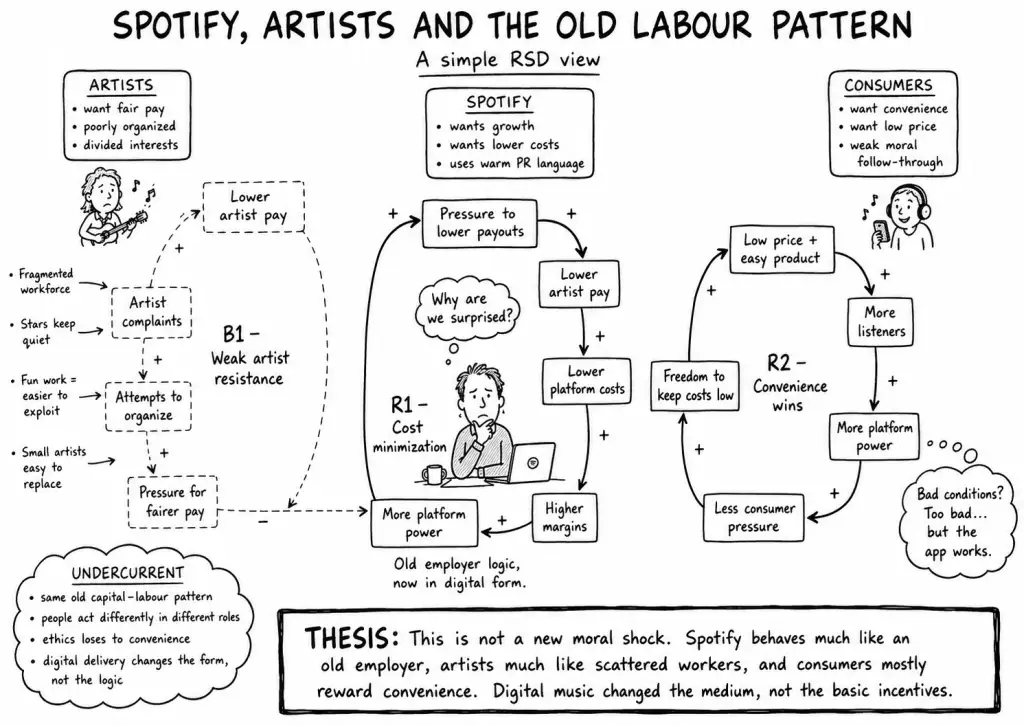
Update: I had second thoughts, this looks like the traditional employer-employee-consumer setting right? I added a second diagram to the story, scroll to the bottom.
Turn this text into an RSD Light, starting with the system logic followed by the image. As a context: a critical piece about Spotify. It aligns perfectly with my adage that it’s all about profit maximization, and that ethics or passion play no role. People even discuss this openly, and the quote stating that their true competitor is silence is brilliant! For a moment I thought, “here we go again, how naive of the author.” But in the end, he admits it himself: consumers are not critical, they don’t read that book, they don’t dive deeper. And so we find ourselves in the exact same loop—one cannot exist without the other. Spotify’s roots are clear and stem from marketing, which was obvious from the very beginning. The passionate competitor lacks the internal experts to make it better, and the costs are three times higher. Audio has become background wallpaper. The future seems to point toward competition from the likes of YouTube, but the author’s vision of the future won’t materialize—that remains a niche, a playground for hobbyists, etc.
It turned out beautifully. However, I feel it’s still missing an insight I want to convey regarding the “normality” of corporate economic behavior. The irony that we are amazed on the one hand that “they do this without scruples” (think of deliberately pushing their own fake content), while on the other hand, wearing a different hat, we have fully embraced it. I can refer to a diagram by Wijnberg explaining this: “we know everything, but it no longer bothers us.” That element is crucial too; we are actively helping to dig our own grave. Another point: I want to publish this blog post in English, so could you make the next version entirely in English? The icons are perfect!
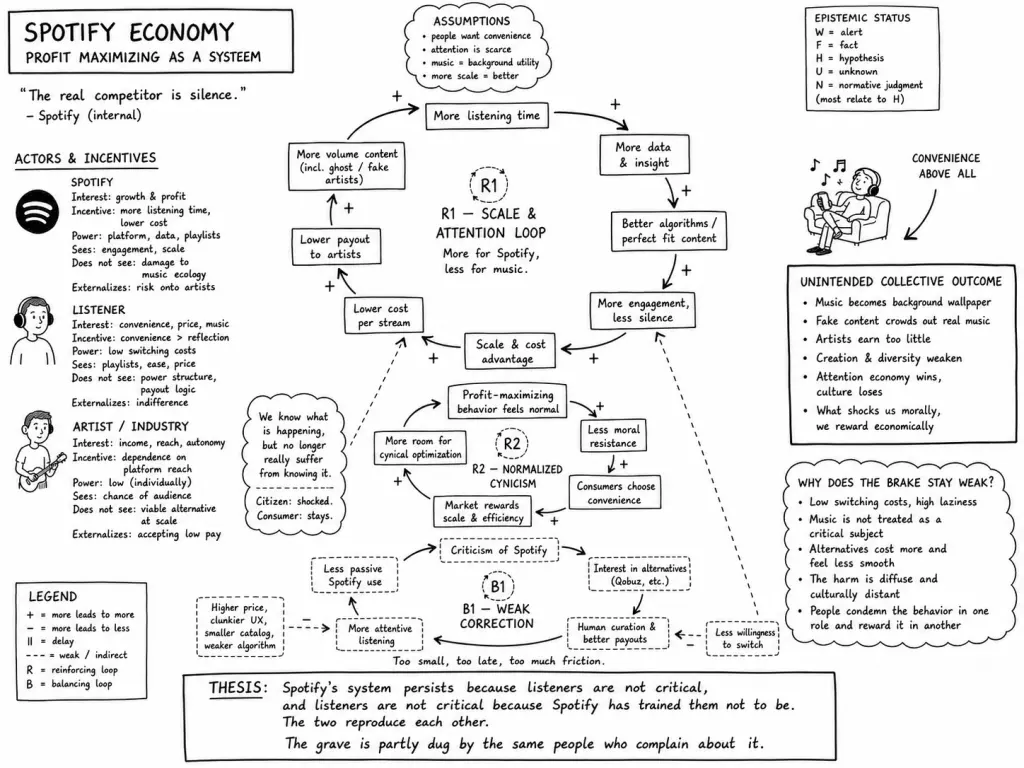
The diagram of the system
Want to see more detail in the pdf?
Explainer
This system dynamics diagram, titled “SPOTIFY ECONOMY: Profit Maximizing as a System”, provides a systemic analysis of how streaming platforms reshape music, listener behavior, and artist compensation. Here is the explanation of the diagram using formal system dynamics concepts.
1. System Structure: The Main Feedback Loops
The diagram centers around two dominant reinforcing loops (engines of growth/escalation) and one weak balancing loop (the failed corrective mechanism).
R1: The Scale & Attention Loop (Reinforcing Loop)
- Mechanic: This is the core economic engine of the platform.
- Dynamics:
- More volume content (incl. ghost / fake artists) -> (+)
- More listening time -> (+)
- More data & insight -> (+)
- Better algorithms / perfect fit content -> (+)
- More engagement, less silence -> (+)
- Scale & cost advantage -> (+)
- Lower cost per stream -> (+)
- Lower payout to artists -> (+)
- More volume content
- Systemic Insight: As listening time increases, Spotify gathers data to refine its recommendation algorithms. This boosts user engagement and solidifies its market scale advantage. Scale allows Spotify to drive down the cost per stream and artist payouts, which incentivize the platform to dilute content with high-volume, lower-cost background music (e.g., ghost artists, functional audio). This further floods the system with content, closing the positive feedback loop.
R2: Normalized Cynicism Loop (Reinforcing Loop)
- Mechanic: A psychological and behavioral feedback loop that normalizes platform power.
- Dynamics:
- Profit-maximizing behavior feels normal -> (+)
- Less moral resistance -> (+)
- Consumers choose convenience -> (+)
- Market rewards scale & efficiency -> (+)
- More room for cynical optimization
- Systemic Insight: As listeners prioritize convenience, ethical concerns regarding fair artist pay erode. The market rewards Spotify’s scale and efficiency, granting the platform more room for cynical optimization without facing consumer backlash.
B1: Weak Correction Loop (Balancing Loop)
- Mechanic: The potential counter-system meant to regulate or limit platform dominance.
- Dynamics:
- Criticism of Spotify -> [weak]
- Interest in alternatives (Qobuz, etc.) -> [weak]
- Human curation & better payouts -> [weak]
- Less willingness to switch -> (-)
- More engagement, less silence
- Systemic Failure: In theory, criticism of platform practices should drive listeners to alternative services with better payout models or human curation. However, this balancing loop is marked with dashed lines indicating high friction and weak gain. Factors like lower switching willingness, higher prices elsewhere, and clunkier user experiences (UX) prevent this loop from exerting sufficient leverage to balance R1.
2. Actors & Bounded Rationality
The left panel highlights how the system’s actors operate under bounded rationality—making locally rational choices that drive globally undesirable outcomes:
- Spotify: Rational interest in profit and growth. Externalizes the financial risk onto artists and ignores long-term damage to the music ecosystem.
- The Listener: Rational interest in convenience and low cost. Sees algorithmic ease; fails to see platform power dynamics and externalizes personal indifference.
- The Artist / Industry: Rational interest in reach and income. Trapped by low individual bargaining power; forced to accept lower payout structures because no viable alternative exists at scale.
3. System Artifacts & Assumptions
- Underlying Mental Models (Assumptions): The top cloud outlines the core mental models generating this system structure: Attention is scarce, music is treated as background utility, and more scale is inherently better.
- Delays & Friction: Significant friction and delays prevent alternative platforms or attentive listening habits from altering the primary loop (R1).
- Unintended Collective Outcomes: The macro-level behavior generated by this structure includes the devaluation of music into “background wallpaper,” the crowd-out of real artists by artificial/cheap content, and a culture loss where “what shocks us morally, we reward economically.”
System Thesis
As stated at the bottom of the diagram:
Thesis: Spotify’s system persists because listeners are not critical, and listeners are not critical because Spotify has trained them not to be. The two reproduce each other. The grave is partly dug by the same people who complain about it.
In system terms, the platform has successfully locked in a self-reinforcing market monopoly (R1) while dampening any balancing feedback mechanisms (B1) by reconditioning consumer preferences toward frictionless convenience.
Second thoughts
I’d also note that this whole discussion closely mirrors the age-old dynamics between employer and employee. Spotify is the employer, and the artists are the workers. They bicker over pay, but the employer is solely focused on keeping costs down—while offering a soothing narrative about how “our people are our most valuable asset.” Blah blah blah. Naturally, there are minor worker rebellions, while the high earners keep their mouths shut. The workers are poorly organized and easily played off against one another, especially since they genuinely love their work and those who get frustrated can easily be replaced.
Then it comes down to the consumer. The consumer couldn’t care less; they just want a good product that doesn’t cost too much. Sure, they might occasionally hear something about poor working conditions or environmental issues, but they don’t lose any sleep over it—life goes on. Nothing new under the sun.
So the real problem lies with the lazy consumer wearing multiple hats, and with the vast majority of small musicians who are left out in the cold, unable to form a united front. In turn, I am amazed by the general amazement at all this. Why on earth would things be any different now, just because content is digital instead of on vinyl or CD?
Back to basics